Companies are art projects
I was triggered recently by a quote from Steve Blank on how the best entrepreneurs are artists that want to put in the world a vision of their own.
I had taken his famous class at Stanford: the Lean Launchpad. It follows the Lean method he laid out, which Eric Ries crystallized in the famous “The Lean Startup” book. This was a book I had encountered in Paris many times; a book that entrepreneurs in France swore by. There was a clear, rigorous method to follow; one that made it seem like making a company is mostly a process and that you can just follow it by talking to enough people and analyzing everything that comes out of it.
So why compare founders to artists? I recently realized that there is no real paradox here.
When you took the class, you could see that Steve was the least “follow the book straight to the line” of all the teachers. He understood that a general method needed to be interpreted (and stretched) when the entrepreneur’s intuition pointed at doing something that might look unconventional (or even stupid). For all the misunderstandings we seemed to have–Steve did not seem to get our idea of where robotics would go–he was at the same time the most open to changing his mind. He knew that you have to be a bit crazy on the idea. Arguably, what we pitched at the end of the class WAS crazy. 6 months later, when we raised our pre-seed, it was still crazy.
And yet we saw something in the future that needed a form of art to be told. It required the mix of a brand, videos, and inspired writings to be conveyed appropriately before it became rationally obvious to everyone else. That's why the best companies are like art projects. They have a soul and a vision, they embody something that is not just a “follow the process and get rich” when the rational process does not point at the path yet.
When the vision isn't clear yet, good companies always have some kind of element of craziness, something different about them. But the most attractive ones are the ones telling a compelling story. Founders like Elon, David Holz of Midjourney, Dario from Anthropic… they tell you something about the world they see, and do so in their very own way.
It’s actually very important that they do it in their very own way.
The medium is the message
As a founder, when going direct with your communication, the medium is the message. Elon has grand speeches or awkward interviews, which are his signature. Dario has his blog posts. David has the videos he made for Midjourney which are his particular style. Roy Lee’s success is probably a consequence of his vitriolic style.
These are extremely different from the average communication styles you see in most startups copying trendy formats. You need extreme confidence to act like this, because you’re standing out twice when both the content and the medium are following your own vibe.
In undergrad, I used to direct a student organization making videos and shows, that was massively successful. There was something to it that was fun and purposeful, and we appeared as such for the rest of the student body. It attracted people who wanted to film what was going on and, as our mission statement said, “be the memory of the campus”.
In the years since then, I found that when the organization attracted less people, it was because they had forgotten about their purpose. It's when you have a purpose and you create media that expresses it, that you attract both customers and hires. This is what Jobs expressed by saying the most powerful person is the storyteller.
Building as a medium
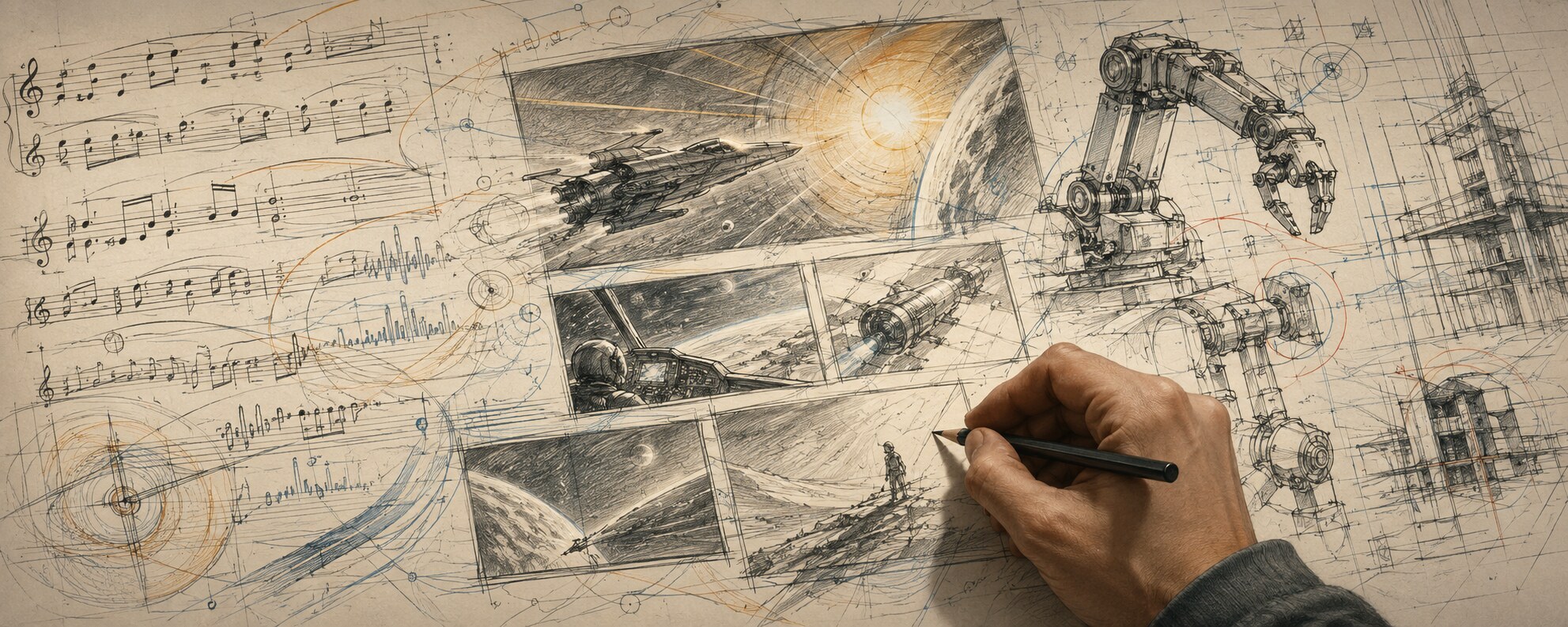
Founders are also artists in that their product seems more of a representation of what they believe than a solution to a problem (while obviously being one). The act of artistic creation plays a huge role in it. And the joy of the founder arises from the process of drawing designs, of imagining something very representative of themselves. Even as it is the result of a team effort, the team follows a kind of artistic calling that leads all of them to be consistent in their work.
Building, itself, is a medium. It’s been most visible lately when expressed as games which are the most immersive medium possible. Just like you paint a figure, layer notes on a DAW or edit a dolly in Premiere, building a game was, at least for me, a way of expressing myself. And there’s a reason why a lot of founders started this way. Hell the amount of technical founders I know that started with building around Minecraft–the best coding blank slate that exists– is staggering. We started as artists, and we see our craft as such.
I am using software analogies because, for inhabitants of Silicon Valley, building has been akin to coding for the past 20 years, but obviously hardware builders work the same way. If anything, by putting their builds out there in the physical world, it could be seen as a superior type of art, but who the hell am I to make comparisons (well, yeah, a hardware founder).
We are builders, but we are maybe first and foremost artists. I have come to believe that to be good founders we need to cultivate this, and that comes by practice all types of art. From drawing, to music, to video editing, to design and crafting by hand and all sorts of things. And as I end editing this piece, I am sitting on the side of the pool realizing that today I practiced 3 or 4 different types of craft for the company, and I feel completely myself.
There used to be a time when I thought I would either be an engineer or an artist. It is a beautiful realization to see that today, I can be both.